
Firmware gives an electronic product its operating behaviour. Bare-metal and real-time operating system development connects the product logic to the selected microcontroller and peripherals. It is intended for products that acquire data, communicate, control an output or manage power within defined hardware and timing constraints.
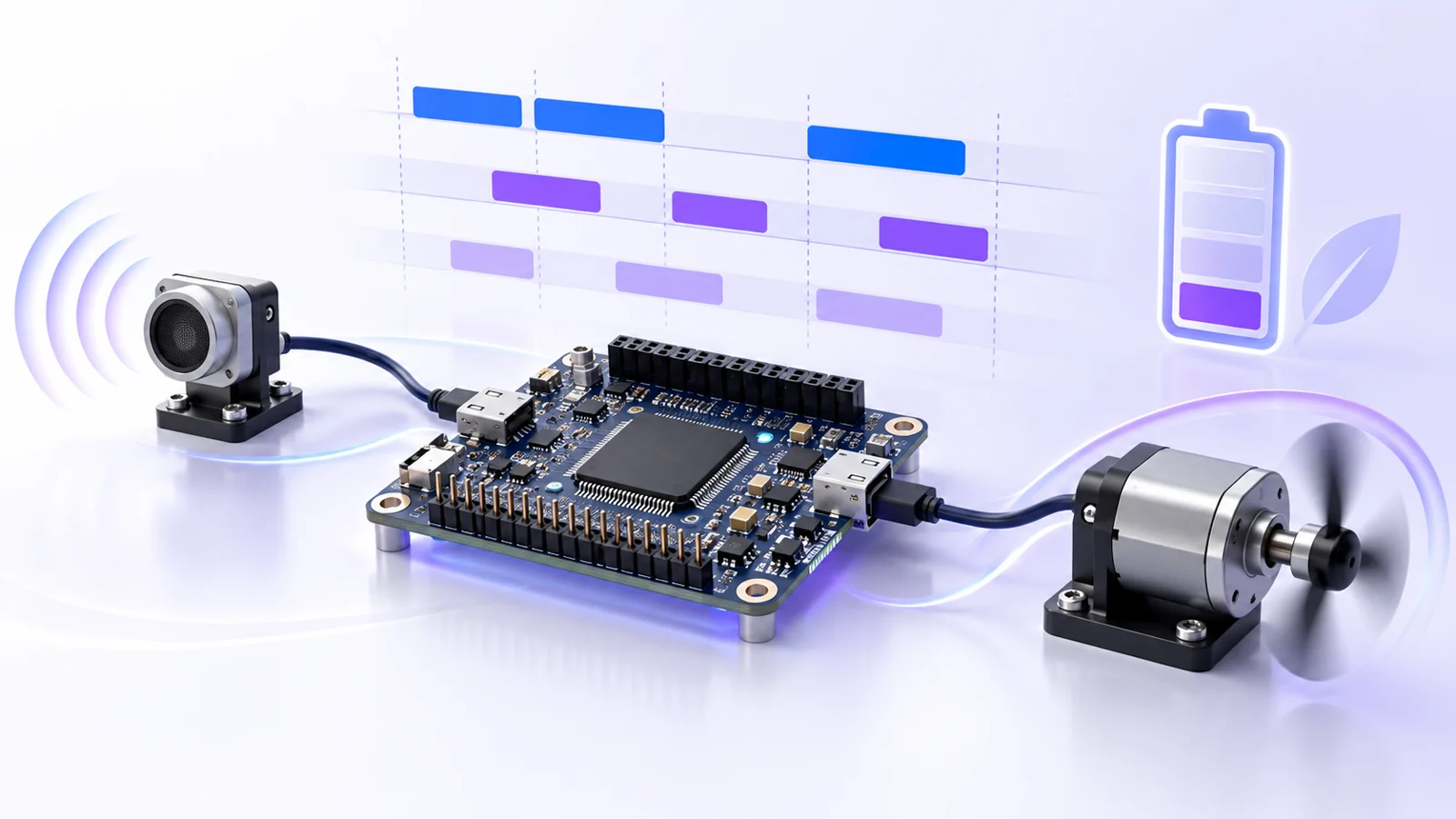
Application behaviour and state machines. Translate product requirements into startup, normal-operation, fault and recovery states. Define what the device does when a sensor fails or a connection is lost. Keep the behaviour explicit so it can be tested and understood by the product owner.
Tasks and peripheral control. Develop the interfaces to the selected microcontroller peripherals and organize application tasks around their timing needs. For an RTOS design, review scheduling, resource sharing and memory use.
Power and update behaviour. Scope sleep states, wake-up events, retained configuration and the response to power interruption. Firmware update and rollback features can be considered where required, with the security and production workflow agreed as part of the project.
Battery-powered sensor. Coordinate sampling, radio communication and low-power states so the product can be evaluated against its actual use pattern.
Industrial control module. Implement a defined control sequence, peripheral handling and diagnostic outputs, with safe-state responsibilities agreed by the customer and engineering team.
The handover includes source code, configuration, a reproducible build, interface notes, state definitions and a test report tied to the target hardware. If third-party middleware is used, document its version and licensing requirements. Hardware-in-the-loop testing can be scoped when the project needs repeatable interaction with physical inputs and outputs.
Share schematics, processor selection, timing requirements, power limits and existing firmware. Identify the critical failure modes and acceptance tests. Include the selected RTOS, compiler and debugging environment in the project brief.
Exercise concurrent input activity and fault recovery on the device. Measure the timing that matters to the application and record memory or resource constraints alongside the tested configuration.