
NexXora’s FDM service covers prototyping, design validation and low-volume builds. Discuss ABS, PLA, PETG or nylon against the part requirements, along with finishing and CAD/CAM support. FDM builds the part through deposited thermoplastic layers, so geometry, orientation and material choice affect its practical use.
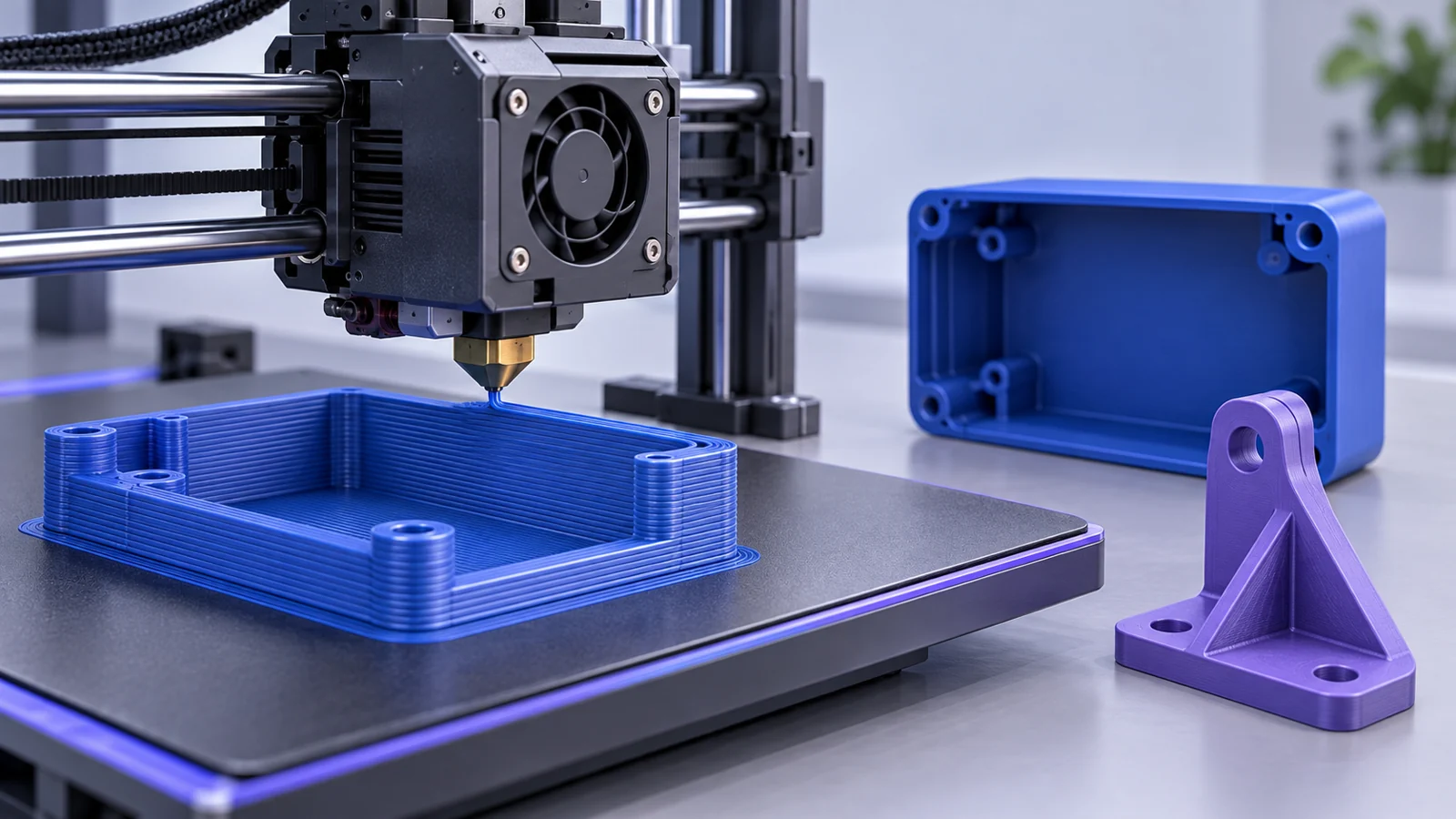
Concept and fit models. Produce a model to check the overall envelope, connector access or the relationship between mating parts. Agree which dimensions need inspection and whether the model is intended only for review or also for a functional test. A visual model is not automatically a production-equivalent part.
Fixtures and functional prototypes. Applications include assembly aids, positioning fixtures and equipment covers when the chosen material and geometry suit the load and environment. Review layer direction, fastening features and repeated-use requirements before selecting a build orientation.
Design preparation and finishing. Review the model for features that affect printing and support removal. Scope sanding, painting or coating where appropriate to the material and intended use. A finished appearance does not by itself establish strength, temperature resistance or environmental durability.
Electronics development. Check an enclosure around a prototype PCB and confirm access to connectors before a more expensive manufacturing step.
Manufacturing support. Evaluate a simple positioning aid or assembly fixture using a defined trial rather than treating a printed tool as qualified for every production task.
Agree the model revision, material specification, orientation where it matters, finish and inspection record. If the part will be loaded or exposed to heat, identify the test that establishes suitability. Production quantity and repeatability requirements should be discussed separately from a one-off prototype request.
Provide the model and drawing, quantity, critical dimensions, colour or finish needs and the operating environment. State whether the purpose is appearance, fit, function or tooling. Current material availability and achievable tolerances must be confirmed for the actual build rather than taken from a general process description.